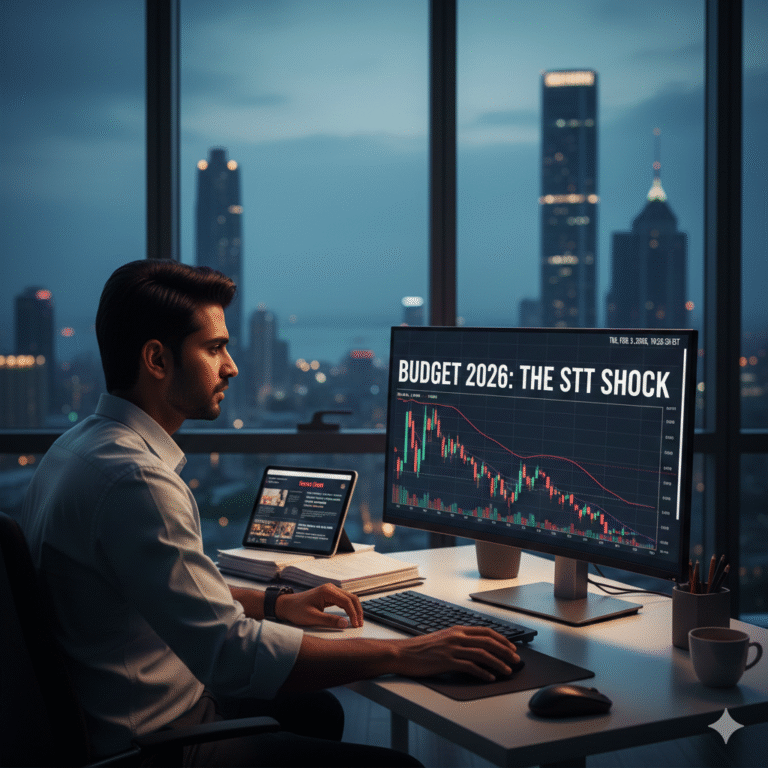

The Union Budget 2026 was presented on Sunday, February 1, 2026, marking a historic shift as it was the first time the budget was unveiled on a weekend. While the government focused on long-term infrastructure and “Yuva Shakti” (Youth Power), the stock market had a visceral reaction to specific tax tweaks.
Here is a blog-style breakdown of the key highlights and their impact on your portfolio.
🏛️ Budget 2026: The Big Picture
Finance Minister Nirmala Sitharaman’s 9th consecutive budget was a blueprint for a “Viksit Bharat.” The government maintained fiscal discipline, targeting a fiscal deficit of 4.3% for FY27, down from 4.4% in the current year.
Key Macro Highlights:
-
Capex Push: Public capital expenditure was hiked to ₹12.2 lakh crore (an 8.9% increase), continuing the focus on roads, railways, and bridges.
-
Manufacturing Focus: Launch of Semiconductor Mission 2.0 and a new Container Manufacturing Scheme with a ₹10,000 crore outlay.
-
The “Orange Economy”: A new focus on the creative industry (AVGC – Animation, Visual Effects, Gaming, and Comics) with content creator labs in 15,000 schools.
📉 Share Market Reaction: The “STT Shock”
While the long-term outlook remains stable, the immediate market reaction was a sea of red. On the special Sunday trading session, the Sensex crashed over 1,500 points and the Nifty 50 dropped 1.95% to settle below 24,825.
Why the Sell-off?
The primary culprit was the hike in Securities Transaction Tax (STT) on derivatives, aimed at curbing “excessive speculation” in the F&O (Futures & Options) segment.
| Segment | Old Rate | New Rate (Effective April 1, 2026) |
| STT on Futures | 0.02% | 0.05% |
| STT on Options (Premium) | 0.1% | 0.15% |
| STT on Exercised Options | 0.125% | 0.15% |
Impact: This increase directly hits high-frequency traders and retail participants in the F&O segment. Brokerage stocks and exchange shares (like BSE and Angel One) saw sharp declines of 5–9% as investors feared lower trading volumes.
💰 Key Tax Changes for Investors
Beyond the STT, there are two major shifts that every investor should note:
-
Sovereign Gold Bonds (SGBs) Lose Their Shine: Previously, capital gains at maturity were tax-free for everyone. Under Budget 2026, this exemption is only available to original subscribers. If you buy SGBs from the secondary market (Stock Exchange), you will now pay capital gains tax at maturity.
-
Share Buybacks: All share buybacks will now be taxed as capital gains for shareholders. This removes the tax arbitrage that companies previously used to return cash to shareholders more cheaply than dividends.
🚀 Sector Winners and Losers
✅ Winners
-
Infrastructure & Capital Goods: Companies involved in construction and railways benefit from the ₹12.2 lakh crore capex.
-
IT & Digital Services: A “Safe Harbour” margin of 15.5% and a tax holiday for global data centers until 2047 boosted sentiment for mid-cap IT.
-
Defense: A record allocation of ₹7.85 lakh crore (up 15%) keeps the momentum high for domestic defense manufacturers.
-
Biopharma: The “Biopharma Shakti” initiative (₹10,000 crore) is set to boost research-heavy pharma stocks.
❌ Losers
-
Stock Exchanges & Brokerages: Hit by the STT hike.
-
Banking (Short-term): Subdued due to the announcement of a high-level committee to review the sector, creating temporary policy uncertainty.
💡 The Verdict
Budget 2026 is a “long-term gain, short-term pain” scenario. While the tax on trading and SGBs stung the market, the continued focus on manufacturing, electronics (₹40,000 crore outlay), and fiscal prudence suggests the structural bull run for India remains intact.


